
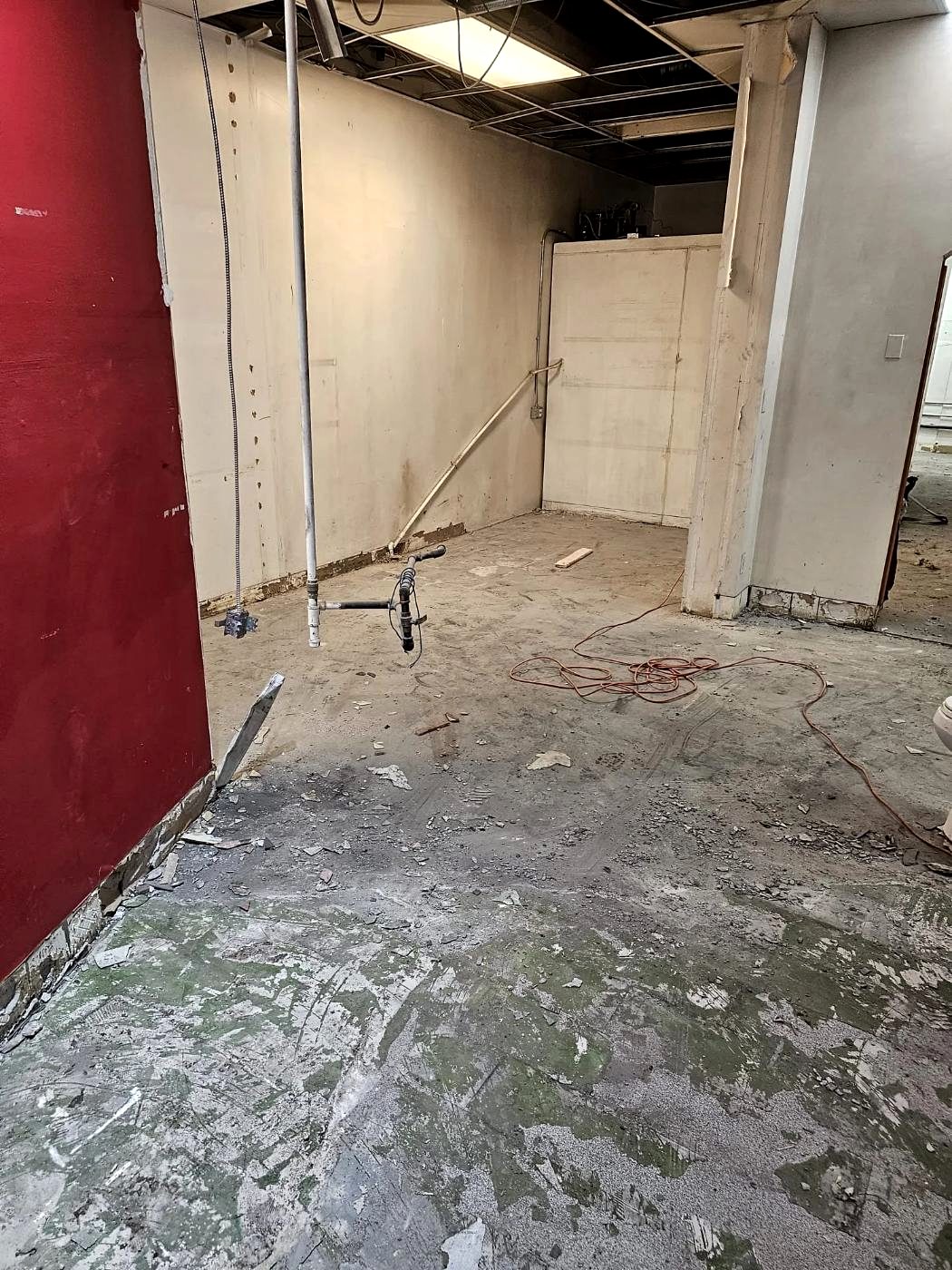
The demolition is the easy part
Taking a wall out is straightforward. Taking a wall out on the fourth floor of a building where two floors are trading, the elevator is shared with the public, and the landlord has a noise clause — that is a logistics problem wearing a demolition costume. Most of what goes wrong on occupied-building work goes wrong in the planning, not the swinging.
Containment
A sealed barrier between the work and the occupied space, taped and sealed at the floor, ceiling and every penetration. Poly on a stud frame is standard; hoarding where the barrier has to take knocks or stay up for weeks. The test is simple: if you can smell the work from the other side, the barrier is not doing its job.
Where the building's air handling would carry dust into occupied space, the work area is put under negative air — extracted through filtration so air flows into the work zone rather than out of it. Returns in the work area get sealed so the base building system is not pulling debris through the whole floor.
Protection
Floors covered on the route in and out, corners and door frames protected, elevator cabs padded and the lobby floor covered if the route crosses it. This is the part that shows up in the landlord's damage deposit conversation, and it is far cheaper to do properly than to repair.
The route
Decide before the first day: which door material leaves by, which elevator, which corridor, where the bin sits, and when. A route that crosses tenant or public traffic will eventually cause an incident. A route that has to be booked — a shared dock, a service elevator with a schedule — needs those bookings in place before the crew arrives, not negotiated on the morning.
Hours
Most occupied work splits into daytime work that is quiet enough to run alongside the tenants, and noisy work — coring, breaking, anything percussive — confined to evenings, early mornings or weekends. Get the acceptable windows in writing from the landlord or property manager, because "we did not know" is not a defence when a tenant complains.
Daily clean-down
Swept and cleared at the end of every shift, not the end of the job. On a building where people are still working or living, an untidy site is what generates the complaint that stops the work, and the cost of a shutdown dwarfs the cost of sweeping.
What to put in the scope before you award it
- Where the barrier goes and what it is built from
- Whether negative air is required, and who supplies it
- The protected route, and any bookings the contractor must make
- Permitted working hours, and who owns the relationship with the landlord
- Clean-down standard and frequency
- Who is responsible for the fire-alarm isolation and reinstatement, if any
A demolition contractor who reads that list and has an answer to each item has done this before. One who says "we will figure it out on site" is telling you something useful.